
Search
Close this search box
Course
Housekeeping Staff Etiquette – Home & Office
A
Dining Etiquette: The Art of the Table
services
Dining Etiquette: The Art of the Table

Crafting new bright brand unique visual systems digital experience focused on wide range of original collabs.

Elevating Everyday Service with Professionalism and Care
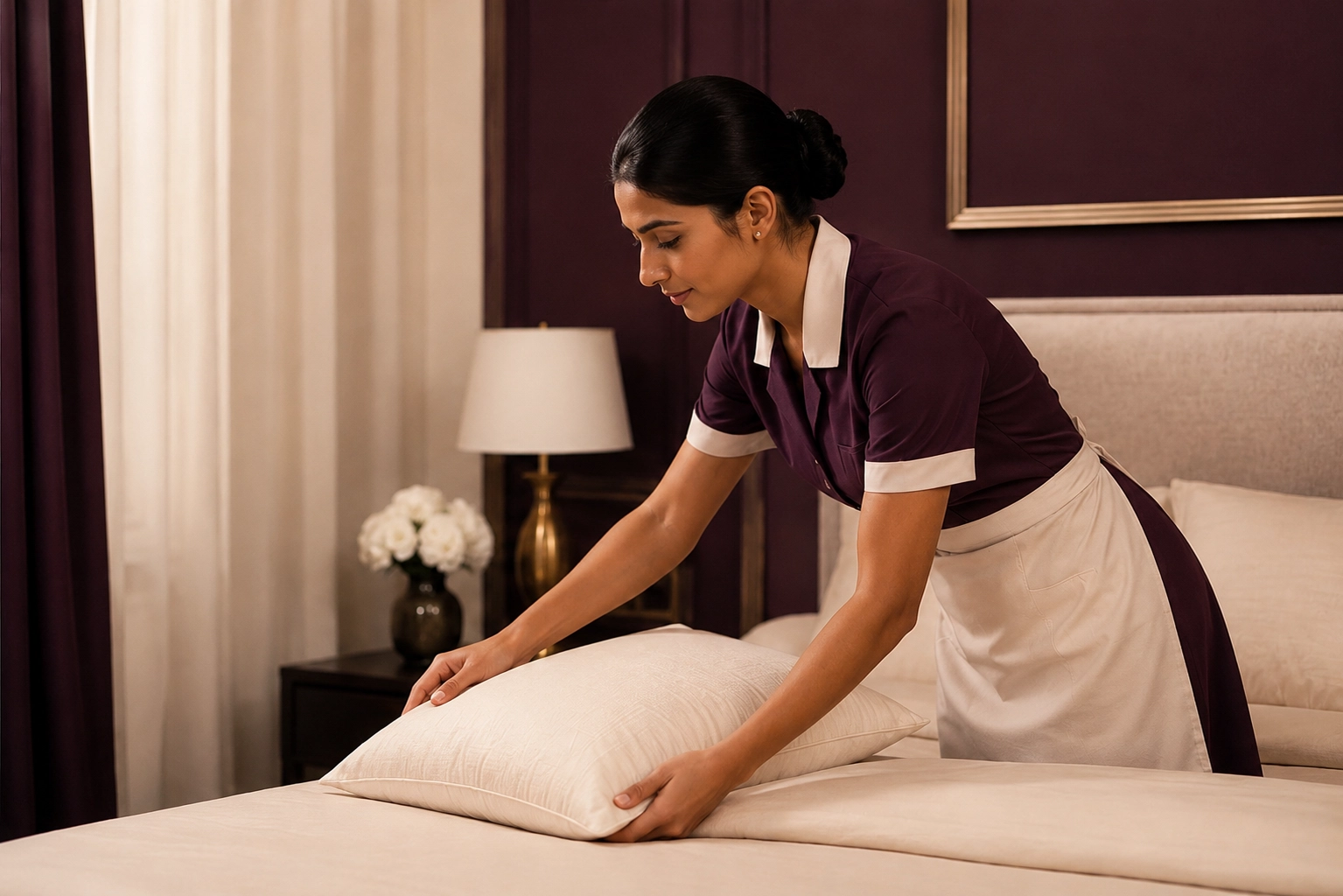
Professional housekeeping goes beyond maintaining clean and organised spaces; it is also about providing service with discretion, respect and attention to detail. Our Housekeeping Staff Etiquette – Home & Office course focuses on developing the professional conduct and service skills required in both private residences and workplace environments. From personal grooming, communication and body language to privacy, room-entry etiquette, handling personal belongings, guest interaction, food and beverage service and managing requests, the program helps staff understand the finer standards of thoughtful and dependable service.
The course is designed to instil a strong sense of responsibility, discretion and service excellence in housekeeping staff. With guidance from certified etiquette consultant Alisha Sachdev, participants gain practical skills to manage their everyday duties with greater confidence, respect and attention to detail, ensuring they consistently maintain the standards expected in both private homes and professional workplaces.
The course is designed to instil a strong sense of responsibility, discretion and service excellence in housekeeping staff. With guidance from certified etiquette consultant Alisha Sachdev, participants gain practical skills to manage their everyday duties with greater confidence, respect and attention to detail, ensuring they consistently maintain the standards expected in both private homes and professional workplaces.
Course Description
Develop the professional conduct and service standards required for housekeeping staff in homes and offices. This program focuses on personal grooming, communication, privacy, room-entry etiquette, guest interaction, handling belongings, food and beverage service and workplace discipline, helping staff perform their responsibilities with professionalism, discretion and attention to detail.
Understand the importance of maintaining high standards of personal hygiene and grooming while on duty. Learn appropriate standards for clean uniforms, neat hair, nails, oral hygiene, body odour and overall presentation to ensure a fresh and professional appearance at all times.
Develop a responsible and disciplined approach to everyday duties through punctuality, reliability, attentiveness and appropriate workplace behaviour. Understand the importance of following routines, completing tasks efficiently and maintaining professional standards even when working without direct supervision.
Learn how to communicate politely and respectfully with employers, family members, guests, colleagues and office personnel. Understand the importance of tone of voice, active listening, appropriate posture, facial expressions and avoiding behaviours such as interrupting, arguing or appearing inattentive.
Understand the importance of discretion when working within private homes and professional offices. Learn to respect personal conversations, confidential documents, family or business information, private spaces and belongings, while avoiding gossip, unnecessary curiosity or sharing information with others.
Learn the correct etiquette for entering bedrooms, cabins, meeting rooms and other private or occupied spaces. Understand when to knock, announce your presence, seek permission and return later, while carrying out cleaning duties with minimum disturbance to those present.
Learn how to greet and acknowledge guests, visitors and senior personnel politely while maintaining appropriate professional boundaries. Understand when to offer assistance, inform the concerned person of a visitor's arrival and provide basic hospitality without becoming overly familiar or intrusive.
Understand how to handle clothing, documents, electronics, valuables and personal possessions with care and respect. Learn when items may be moved during cleaning, when permission should be sought and how to immediately report anything that is damaged, misplaced or found unattended.
Learn the essentials of preparing and presenting trays neatly, serving tea, coffee, water and refreshments, and placing items appropriately. Understand serving sequence, refilling, clearing and how to provide food and beverage service discreetly in both home and office environments.
Understand the fundamentals of table setting, meal service and clearing for everyday as well as more formal occasions. Learn appropriate handling of crockery, cutlery and glassware, along with the basics of bar setup and serving beverages neatly, safely and discreetly.
Learn how to answer household or office telephones professionally, take accurate messages and communicate information clearly. Understand appropriate etiquette for answering doors, receiving guests, accepting deliveries and dealing with unknown visitors without compromising privacy or security.
Learn to listen carefully to instructions, clarify when necessary and respond to special requests with a helpful attitude. Understand how to acknowledge mistakes, report breakages or problems promptly, apologise appropriately and seek assistance rather than hiding errors, making excuses or assigning blame.
Develop the ability to work respectfully and efficiently with other household or office staff, supervisors and managers. Learn to coordinate responsibilities, provide appropriate updates, anticipate routine requirements and notice the small details that contribute to a well-organised and smoothly managed environment.
Course Outcome
By the end of the Dining Etiquette Programe, you will have transformed your approach to dining, equipped with the skills to confidently navigate any meal, from the most casual brunch to the most elaborate banquet. Join us and take the first step towards mastering the art of dining with style and sophistication.
Who Should Enroll?
This programme is ideal for:

Professionals
Individuals preparing for corporate events, networking dinners, or
business meetings where you would like to project confidence and professionalism.
Socialites
Individuals who frequently attend social gatherings and wish to enhance their dining etiquette for a more polished experience.
Students
Young adults who are preparing themselves for greater academic or professional challenges where fine dining manners will be essential.
Anyone Interested in Fine Dining
People who want to elevate their dining experience and learn the nuances of etiquette to impress guests or hosts.
FAQs
Basic etiquette that should be followed at the table are of respect, courtesy, and awareness about people at the table. This can be started with the act of waiting for everybody to be seated and waiting for the host to let one know when to start eating. Use cutlery according to the table setting etiquette. Sit up straight, do not lean with your elbows against the table, and do not cross over to reach the food, politely ask if things may be passed across. Chew with your mouth closed, eat small bites, and never speak while you are eating. These simple dinner manners exhibit courtesy and enrich the dinner experience for all.
Handling cutlery is a major part of dining etiquette. In formal dining etiquette, the rule of thumb is to work from the outside in with cutlery. Usually, the fork is placed on the left side, while the knife and spoon are on the right side. For cutting, you use the fork in your left hand and the knife in your right hand. To signal you are done with your meal, place the cutlery on the plate in the following positions, cross the fork and knife diagonally or in an inverted "V". When you are all done, place them parallel to each other on the plate. Proper use of cutlery is one of the primary aspects of table manners, it shows your considerations for the people you are dining with.
Many individuals commit some general oversights that can undermine dining table etiquette. Never chew and talk simultaneously, nor use other cacophonous sounds like slurping, never text or play at the table, graciously concentrate on your dining partners. Be careful not to lean forward across others, just ask to have items passed to you instead. Avoid resting elbows on the table, and refrain from seasoning food before tasting it, as this can be seen as disrespectful to the host or chef. Fine dining etiquette makes every experience enjoyable.
Formal dining etiquette is more formalized. Each element in the place setting has to be identified, a napkin is positioned to the left and above the knife, a dinner plate to the immediate left, glasses to the right, and utensils. Wait for a signal from the host to commence eating and eat at the same tempo as the rest of the group. Follow the table etiquette rule of using the outermost utensil for each new course. In formal dining, you should have poise and grace, maintain eye contact, and contribute to soft conversation without raising your voice. Formal dining etiquette is about showing respect to the host and to the event.
Dining etiquette classes are useful for any person who would want to feel sure and not nervous in such formal setups. The key lessons one gets in dining etiquette classes include how to handle utensils and cutlery, how the placement of a napkin should be, the managing of multiple courses, and knowing when to start or pause during meals. Classes are also conducted on basic dining etiquette and advanced table etiquette in formal occasions that help an individual master social graces and dining manners etiquette. Knowledge of the etiquette of dining can uplift personal and professional interactions to leave an impression in any dining situation.
Monday - Saturday : 09:30 am - 07:30 pm

Helping individuals cultivate graceful manners, confident communication, and a polished personal presence.
